Okonomiyaki on the Home Griddle: Why Osaka Mixes and Hiroshima Builds Layers
A culturally grounded guide to Kansai- and Hiroshima-style okonomiyaki, followed by a flexible Saudi-friendly home recipe with clear allergen and egg-safety notes.
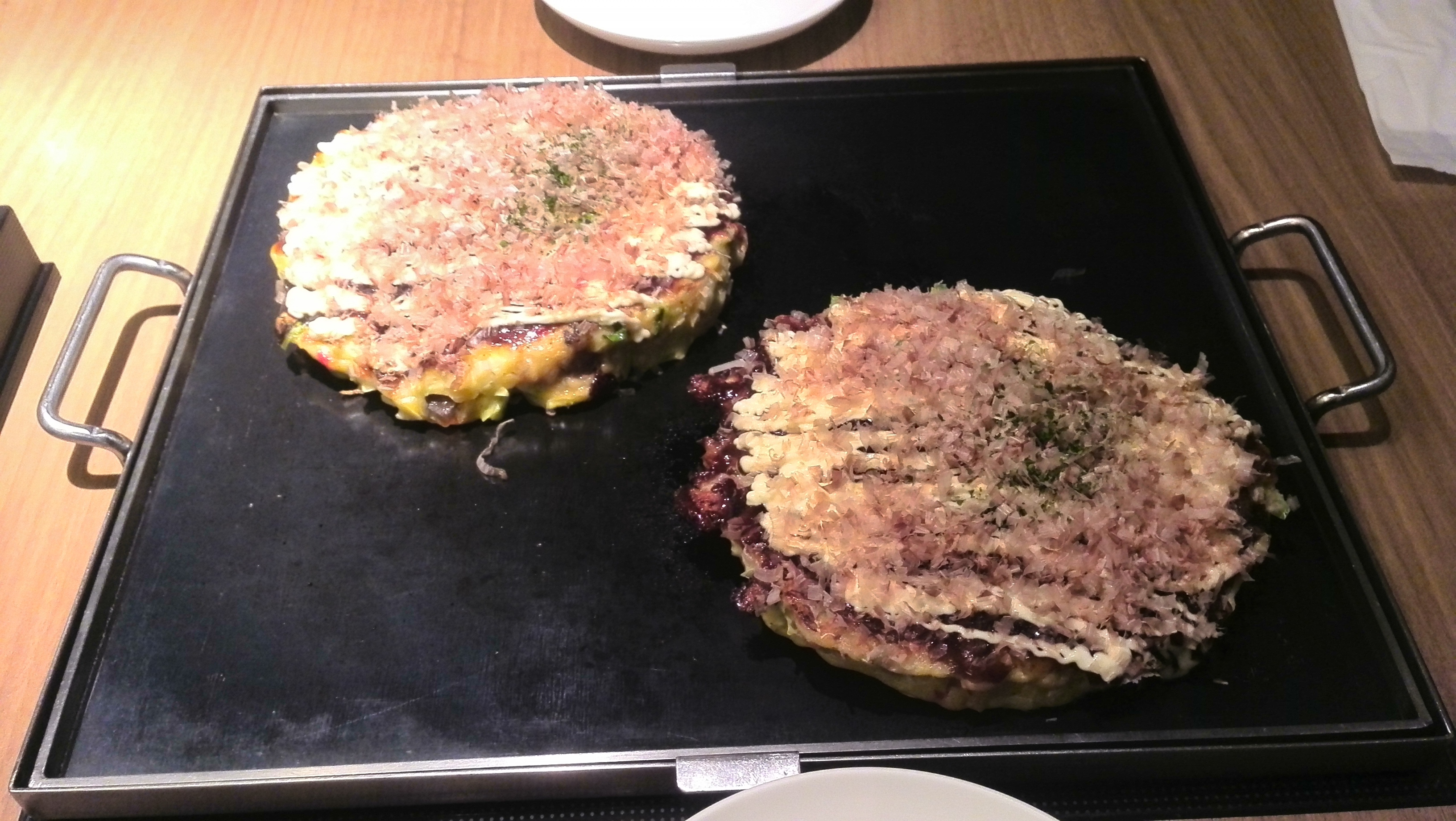
Okonomiyaki is often loosely translated as ‘grilled as you like it’, but freedom with toppings does not erase the dish’s regional identities. In Kansai, cabbage, flour, egg and stock are mixed into a single pancake. In Hiroshima, the components are layered, and noodles commonly become part of the architecture.
Our home recipe takes its cue from Kansai technique rather than claiming to be a definitive version. It uses a vegetable-forward base and sautéed mushrooms that are practical in Saudi kitchens. Traditional meat is discussed in context; the local adaptation is labelled honestly.
Two schools, no single winner
The Japan National Tourism Organization describes Kansai-style okonomiyaki as cabbage, flour and egg cooked on an iron griddle, commonly finished with sliced pork, savoury-sweet sauce, Japanese mayonnaise and aonori. Its Hiroshima account describes a layered build that also includes noodles.
That difference changes the eating experience. Mixing distributes cabbage through a cohesive cake; layering lets cabbage, batter, egg and noodles keep clearer identities. Comparing them is useful only if we resist flattening two local traditions into one recipe.
Moderate heat, restrained batter
A good home pancake is not rescued by extra flour. The batter should bind the cabbage rather than bury it. Cold stock or water, minimal mixing and a pancake around two centimetres thick give the centre time to set before the surface burns.
Wait for the edges to firm before flipping, and use two wide spatulas if that feels safer. Repeated pressing drives out steam and makes the pancake dense. These are Yummy Food test-kitchen choices, not claims of authenticity.
A Saudi adaptation that names itself
JNTO lists sliced pork in a common Kansai preparation. Our recipe does not use it: sautéed mushrooms provide savoury depth, while fully pre-cooked halal chicken is an optional local adaptation. Neither is presented as a traditional equivalent.
Cold water can replace dashi, or use kombu–shiitake stock for a fish-free base. Okonomiyaki sauce, Japanese mayonnaise, aonori and bonito flakes are optional. Read every label because wheat, soy, egg and fish can appear across several condiments.
Doneness is more than surface colour
FoodSafety.gov lists 71°C/160°F for egg dishes. Check the thickest part of the pancake instead of relying on browning alone. Any chicken addition should be fully cooked to 74°C/165°F before it enters the batter, then reheated thoroughly in the pancake.
Do not taste raw batter. Refrigerate leftovers within two hours—or one hour above 32°C/90°F—and reheat them to 74°C/165°F. These are safety controls, separate from the dish’s cultural history.
Two Kansai-inspired home pancakes
A flexible vegetable-forward base; toppings are optional, but checking egg doneness is not.
- Time
- 35 minutes
- Yield
- 2 pancakes / 2 generous servings
- Level
- Moderate
Ingredients
- 300 g green cabbage, finely shredded
- 120 g plain flour
- 180 ml cold dashi or cold water
- 2 large eggs
- 2 spring onions, sliced
- 100 g mushrooms, sliced and sautéed
- 1 tbsp neutral oil
- Okonomiyaki sauce or a reliably labelled savoury-sweet sauce, optional
- Japanese mayonnaise and aonori, optional
- Bonito flakes, optional and unsuitable for anyone avoiding fish
Method
- 01
Sauté the mushrooms in a clean pan until their moisture evaporates, then cool briefly. Prepare cabbage and onions with clean tools.
- 02
Whisk flour with dashi or water only until no dry pockets remain. Add eggs lightly, then fold in cabbage, spring onions and mushrooms without overmixing.
- 03
Heat a wide pan or griddle over medium heat and oil lightly. Divide into two pancakes, each 15–18 cm wide and about 2 cm thick.
- 04
Cook the first for 5–6 minutes until the edges and base set. Flip with two spatulas, cover and cook another 5–6 minutes without repeated pressing.
- 05
Check the centre at its thickest point; it must reach 71°C/160°F. If not, lower the heat, continue cooking and check again.
- 06
Rest for one minute, then add sauce, mayonnaise, aonori or bonito as desired. Serve immediately and repeat with the second pancake.
Sensible substitutions
- For a fish-free version, use water or kombu–shiitake stock, omit bonito and check the sauce label.
- Replace mushrooms with halal chicken already cooked to 74°C/165°F. This is a local adaptation, not a traditional like-for-like swap.
- For gluten-free cooking, use a trusted labelled flour blend and verify every sauce; the pancake may be more fragile.
Allergy note
- The recipe contains egg and wheat. Dashi and bonito may contain fish; sauces and mayonnaise may contain soy, wheat or egg.
- Read full labels and prevent cross-contact when cooking for anyone with a serious allergy.
Quick safety checklist
- Never taste raw egg-and-flour batter.
- Cook the centre to at least 71°C/160°F.
- Pre-cook any chicken to 74°C/165°F.
- Chill leftovers within two hours, or one hour above 32°C/90°F, and reheat to 74°C/165°F.
Sources and verification
Yummy Food reviewed the official sources and image licence page on 9 August 2026. JNTO-sourced comparisons are separate from our editorial recipe adaptation.
Two tools directly relevant to the method
Technique-led choices without price or availability claims.
A broad surface makes flipping easier; a wide frying pan also works.
Search Amazon.sa ↗02Digital food thermometerChecks the centre rather than guessing from surface colour.
Search Amazon.sa ↗As an Amazon Associate I earn from qualifying purchases.